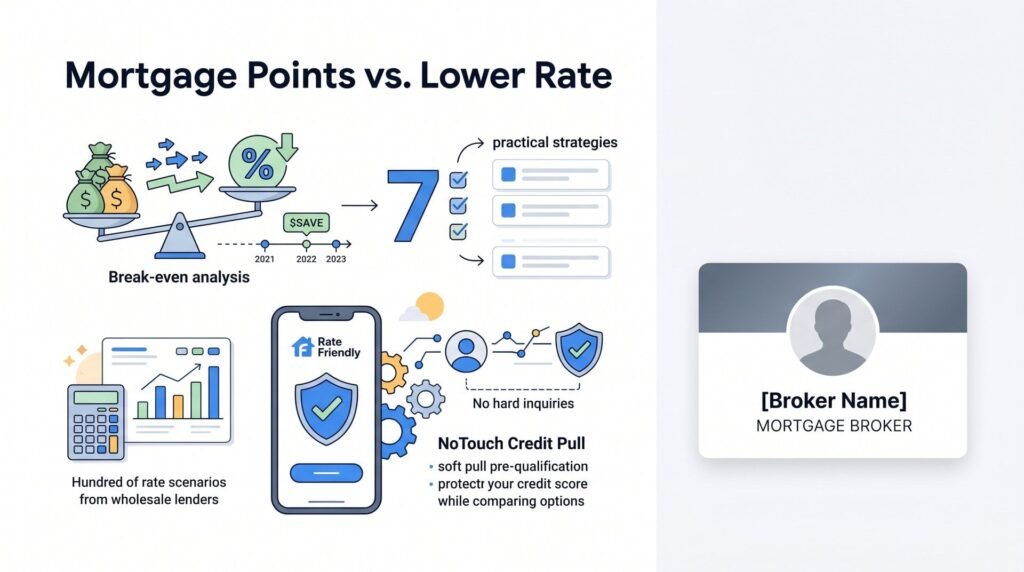

When you’re shopping for a home loan, one of the most confusing decisions you’ll face is whether to pay mortgage points upfront to buy down your interest rate — or simply take the lower rate a broker can find for you across hundreds of wholesale lenders. This isn’t a one-size-fits-all answer, and making the wrong call can cost you thousands of dollars over the life of your loan.
The good news? You can explore both options today through a soft credit pull mortgage with no hard inquiry, no credit score hit, and no pressure. That’s exactly what Rate Friendly’s NoTouch Credit Pull is designed for: get real rate scenarios from hundreds of wholesale lenders without triggering a hard inquiry on your credit report.
In this guide, we’ll walk through seven practical strategies to help you decide when buying points makes sense, when it doesn’t, and how to run the math so you can walk into closing with confidence. Whether you’re a first-time buyer in Virginia, a move-up buyer in Florida, or refinancing in Tennessee or Georgia, these strategies apply to your situation.
By Duane Buziak, NMLS #1110647 | Coast2Coast Mortgage LLC NMLS #376205 | Licensed in VA, FL, TN, GA
Let’s make this decision simple, transparent, and — as always — rate-friendly.
1. Understand What You’re Actually Buying (Discount Points 101)
The Challenge It Solves
Most borrowers walk into a rate conversation without knowing the difference between a discount point and an origination fee. They’re both line items at closing, they both cost money, and they can both appear on the same Loan Estimate — which makes them easy to confuse. That confusion leads to bad comparisons, misinformed decisions, and sometimes real money left on the table.
The Strategy Explained
According to the Consumer Financial Protection Bureau (CFPB), discount points are prepaid interest. One point equals 1% of your loan amount, and paying it upfront typically lowers your interest rate. That’s it. You’re not paying a fee for a service — you’re buying your rate down by paying interest in advance.
An origination fee, by contrast, is what a broker charges for processing and originating your loan. It may or may not affect your rate. The two can appear together on a Loan Estimate, but they serve completely different purposes.
The CFPB also explains lender credits as the exact inverse of discount points: accept a slightly higher interest rate, and the broker applies a credit toward your closing costs. Understanding this spectrum — points on one end, lender credits on the other — is the foundation for every strategy that follows. If you’re new to the home loan process, reviewing your home loan options in Virginia can help you see how points fit into the broader picture.
Implementation Steps
1. Pull your Loan Estimate and locate Section A: “Origination Charges.” Identify any line items labeled “Discount Points” separately from origination fees.
2. Calculate what one point costs on your specific loan: multiply your loan amount by 0.01. On a $350,000 loan, one point = $3,500.
3. Ask your broker to show you the rate with zero points, one point, and two points side by side — so you’re comparing apples to apples before any math is run.
Pro Tips
Always ask for a “zero-point” quote first. Many borrowers don’t realize they’re being quoted a rate that already includes points baked in. Your baseline should always be the rate you qualify for with no upfront cost — then decide whether buying it down makes financial sense from there.
2. Run the Break-Even Math Before You Commit
The Challenge It Solves
Buying points feels like a smart move — who doesn’t want a lower rate? But without running the break-even calculation, you’re guessing. If you sell or refinance before you recoup the upfront cost, you’ve lost money. The break-even formula is the single most actionable calculation a borrower can run before deciding whether points are worth it.
The Strategy Explained
The formula is straightforward: divide your upfront point cost by your monthly payment savings. The result is the number of months you need to stay in the loan to break even. If you plan to stay longer than that, points may make sense. If you’re likely to move or refinance before that point, skip them.
Here’s a real worked example using a $350,000 conventional 30-year fixed loan:
Option A (no points): Rate of 6.875% → estimated monthly principal and interest of approximately $2,299.
Option B (1 point = $3,500): Rate of 6.625% → estimated monthly P&I of approximately $2,241. Monthly savings: roughly $58. Break-even: $3,500 ÷ $58 = approximately 60 months, or about 5 years.
Option C (2 points = $7,000): Rate of 6.375% → estimated monthly P&I of approximately $2,184. Monthly savings versus no points: roughly $115. Break-even: $7,000 ÷ $115 = approximately 61 months, or just over 5 years.
Notice something interesting: in this illustration, going from one point to two points doesn’t dramatically shorten the break-even. That’s a common pattern. The marginal return on each additional point often flattens out, which is why running the math on each increment matters. A side-by-side mortgage rate comparison across multiple lenders makes this analysis far more precise than working from a single quote.
Implementation Steps
1. Get a side-by-side quote showing your rate and payment at zero, one, and two points from your broker.
2. Subtract the lower monthly payment from the higher monthly payment to find your monthly savings.
3. Divide the total point cost by that monthly savings figure. That’s your break-even in months. Compare it honestly to how long you expect to stay in this loan.
Pro Tips
Don’t forget to factor in refinancing risk. If rates drop and you refinance in two or three years, your break-even clock resets to zero. Build that possibility into your timeline before committing to points. Rate examples above are illustrative and subject to change — always get current pricing from your broker.
3. Know When Buying Points Makes Strategic Sense
The Challenge It Solves
Points aren’t universally good or bad — they’re a tool. The problem is that borrowers often make this decision based on how a rate sounds rather than whether their specific situation actually benefits from the upfront investment. Certain borrower profiles genuinely benefit from buying points. Knowing whether you’re one of them is the strategic edge.
The Strategy Explained
Buying discount points tends to make the most sense in these specific scenarios:
Long-term homeowners: If you’re buying a forever home or plan to stay for 10-plus years, a break-even of five years means you’ll enjoy seven or more years of savings on the back end. The longer your horizon, the more points pay off.
High loan balances: On a $600,000 loan, one point costs $6,000 — but the monthly savings are proportionally larger too. The absolute dollar savings per month can make break-even timelines more compelling at higher balances.
Fixed-rate loans: Points make the most sense on fixed-rate products where your rate is locked for the life of the loan. On adjustable-rate products, the calculus changes significantly because your rate will shift regardless.
Cash-rich buyers: If you’ve already covered your down payment and closing costs comfortably, and you have surplus cash, deploying some of it into points can function as a guaranteed return in the form of monthly savings — worth comparing to other uses of that capital.
There is also a potential tax angle. According to IRS Publication 936, points paid on a home purchase mortgage may be fully deductible in the year paid if they meet IRS requirements. For Virginia borrowers, who pay state income tax, this deductibility may carry additional value compared to Florida borrowers, where there is no state income tax. Always consult a qualified tax professional for guidance specific to your situation — this is not tax advice. Borrowers in high-cost markets may also want to explore jumbo loan rates in Virginia to understand how points interact with larger loan amounts.
Implementation Steps
1. Honestly assess your timeline: are you staying 7-plus years, or is there a realistic chance you move or refinance sooner?
2. Check your cash position after closing. Points should never strain your reserves or emergency fund.
3. Ask your tax advisor whether points are deductible in your specific situation before factoring that benefit into your decision.
Pro Tips
The strongest case for points is a high loan balance, long timeline, and surplus cash — all three together. If you only have one or two of those, the case weakens considerably. Run the numbers honestly rather than rationalizing a decision that sounds appealing.
4. Recognize When Skipping Points Is the Smarter Play
The Challenge It Solves
Just as there are borrower profiles where points shine, there are equally clear situations where paying points is a poor use of cash. The risk is that a borrower spends thousands upfront on a rate buydown they’ll never fully recoup — while simultaneously straining the resources they need for other parts of the transaction.
The Strategy Explained
Skip the points if any of these situations describe you:
Short time horizons: Planning to sell within three to four years? You almost certainly won’t hit break-even. Keep the cash and let the market do its work.
Down payment preservation: If buying points means reducing your down payment, you may be trading a lower rate for a higher loan-to-value ratio, private mortgage insurance, or worse loan terms. That’s rarely a good trade.
DPA program users: If you’re using a down payment assistance program like Dynamo DPA (which offers 2.5% or 3.5% assistance with a minimum 580 FICO) or Turbo DPA (which offers 3.5% or 5% assistance, minimum 600 FICO, up to 101.5% CLTV), your cash-to-close structure is already carefully calibrated. Adding points on top can conflict with program limits or simply isn’t the best use of any remaining cash you have available. Borrowers exploring zero down mortgage options in Virginia will find that preserving cash at closing is almost always the priority over buying down a rate.
VA loan borrowers managing the funding fee: VA loans already carry an upfront funding fee, as detailed at VA.gov. Stacking discount points on top of that fee compounds the upfront cost significantly. In many cases, the better strategy is to let the VA’s competitive base rates do the work without adding points to the equation.
Likely refinance candidates: If rates are elevated and you’re expecting to refinance within a few years when conditions improve, buying points now is essentially paying for a rate you plan to replace. Save the cash for your future refinance costs instead.
Implementation Steps
1. Map your realistic timeline to the break-even calculation from Strategy 2. If there’s meaningful uncertainty, lean toward skipping points.
2. If you’re using Dynamo DPA or Turbo DPA, ask your broker to model the transaction with zero points first and confirm program compatibility before adding any upfront costs.
3. If you’re a VA borrower, review your funding fee amount and factor it into your total upfront cost picture before considering points.
Pro Tips
When in doubt, keep the cash. A lower rate is appealing, but liquidity after closing has real value too. Unexpected repairs, moving costs, and life events happen — and having reserves protects you in ways a slightly lower monthly payment cannot.
5. Use Broker Access to Shop Rate vs. Points Combinations Simultaneously
The Challenge It Solves
Here’s something most borrowers don’t realize: the rate-and-points combination you’re offered isn’t fixed. It varies by lender, by day, and by your specific loan profile. A single-shelf retail lender can only show you their own pricing grid. An independent broker accessing hundreds of wholesale lenders can show you dozens of combinations simultaneously — and that difference in visibility is enormous when you’re trying to optimize this decision.
The Strategy Explained
When you work with a broker who has access to 500-plus wholesale lenders, you’re not just getting one rate quote — you’re getting a marketplace of pricing. That means you can see, side by side, what it looks like to take a lower rate with one point from Lender A versus a slightly higher rate with no points from Lender B, versus a higher rate with a lender credit from Lender C.
This is the environment where the mortgage points vs. lower rate decision becomes genuinely informed rather than theoretical. You’re comparing real numbers from real lenders, not hypotheticals.
And here’s the critical part: you can get all of this without a hard inquiry on your credit report. Rate Friendly’s NoTouch Credit Pull uses a Vantage Score 4.0 soft pull to generate real rate pricing across the wholesale market. No hard inquiry, no credit score impact, no obligation. This is what a mortgage pre approval without hard pull actually looks like in practice — real lender pricing, real scenarios, zero credit risk. For a deeper look at how this process works, see our guide on no credit check mortgage options for Virginia homebuyers.
The comparison table below illustrates how broker access changes the picture versus a single-shelf retail approach:
Feature | Independent Broker (Rate Friendly) | Single-Shelf Retail Lender
Lender access | 500+ wholesale lenders | One institution’s products only
Rate/point combinations shown | Multiple, side by side | Limited to one pricing grid
Credit pull to get pricing | Soft pull (NoTouch Credit Pull, Vantage Score 4.0) | Typically requires hard inquiry
Seller concession structuring | Full flexibility across lenders | Limited to one set of guidelines
DPA program availability | Dynamo DPA, Turbo DPA, and more | Varies; often limited
Closing speed | Fastest close times in the market | Varies by institution
Implementation Steps
1. Start with Rate Friendly’s NoTouch Credit Pull — a soft pull that generates real wholesale pricing without touching your credit score.
2. Ask to see three scenarios: zero points, one point, and one with a lender credit. Compare the monthly payments and break-even timelines across all three.
3. Use that comparison to anchor your decision in real numbers before committing to any one structure.
Pro Tips
Wholesale lender pricing changes daily. The combination that looks best on Monday may shift by Thursday. Once you’ve identified your preferred structure, move quickly to lock — rate markets don’t wait for indecision.
6. Factor in Your Loan Program — Points Work Differently Across Products
The Challenge It Solves
The break-even math from Strategy 2 assumes a clean slate. In reality, most loan programs come with their own upfront costs that stack on top of any points you pay. Ignoring that stacking effect can make points look more affordable than they actually are — and change your break-even timeline significantly.
The Strategy Explained
Here’s how points interact with each major loan program:
Conventional loans: The cleanest environment for points. No mandatory upfront fees beyond what you choose to pay. Fannie Mae’s Selling Guide allows discount points as part of the loan structure, and seller concessions can cover them subject to loan-level limits. This is where the break-even math from Strategy 2 applies most directly.
FHA loans: FHA loans carry an upfront mortgage insurance premium (MIP) currently equal to 1.75% of the base loan amount, per HUD guidelines. On a $350,000 loan, that’s $6,125 before you add a single point. Stacking points on top of MIP significantly increases your total upfront cost and extends your effective break-even. Model this carefully. Borrowers who already have an FHA loan and want to reduce their rate without the complexity of points should review the FHA Streamline Refinance as a simpler alternative.
VA loans: VA loans allow discount points, and sellers can pay them on behalf of the veteran buyer per VA.gov. However, the VA funding fee (which varies by down payment and usage) is already an upfront cost. In high-military-concentration markets like Hampton Roads and the Williamsburg corridor in Virginia, VA loans are extremely common — and the funding fee stacking consideration is especially relevant. In many cases, VA base rates are competitive enough that points aren’t necessary at all.
USDA loans: The USDA Single Family Housing Guaranteed Loan Program, detailed at USDA Rural Development, carries an upfront guarantee fee currently equal to 1% of the loan amount. Same stacking dynamic as FHA and VA — factor this into your total upfront cost before adding points.
Cash-out refinances: Rate Friendly offers cash-out refinances up to 90% LTV. On a cash-out refi, the calculus shifts: you’re already pulling equity, so paying points upfront means using borrowed money (or closing cost funds) to buy down a rate you may refinance again in a few years. This is one of the clearest cases where skipping points and taking a lender credit instead often makes more sense.
Implementation Steps
1. Identify your loan program before running any points math. Your broker can confirm which program you qualify for based on your soft-pull profile.
2. Add your program’s mandatory upfront costs (MIP, funding fee, guarantee fee) to any point costs you’re considering. That’s your true total upfront investment.
3. Re-run the break-even calculation using that combined upfront figure against your monthly savings.
Pro Tips
For VA borrowers in Virginia’s military corridors specifically: the VA loan benefit is already one of the strongest rate advantages in the market. Before paying points, ask your broker to show you what the zero-point VA rate looks like against a conventional alternative. The answer often makes the decision easy.
7. Negotiate Points as a Closing Cost — Not Just a Rate Decision
The Challenge It Solves
Most borrowers treat the points decision as a personal finance calculation: do I have the cash, and is the math worth it? But that framing misses a bigger opportunity. Discount points are a closing cost — and closing costs are negotiable. When you reframe points as a negotiable line item rather than a fixed choice, entirely new options open up.
The Strategy Explained
Here’s how the negotiation landscape works:
Seller concessions can pay your points. According to Fannie Mae’s Selling Guide, seller concessions (interested party contributions) can cover discount points on conventional loans, subject to loan-level limits based on your down payment. On FHA and VA loans, similar rules apply. In a buyer-friendly market, or when a seller is motivated, asking them to cover one or two points is a completely legitimate negotiation tactic — and it costs you nothing out of pocket.
Lender credits work in reverse. If your cash-to-close is tight, you can accept a slightly higher rate in exchange for a lender credit that offsets your closing costs. This is the opposite of buying points — and it’s sometimes the right move, especially for borrowers who need to preserve cash after closing.
Homes for Heroes changes the equation for eligible borrowers. If you’re an active-duty service member, veteran, first responder, teacher, or healthcare worker, the Homes for Heroes program provides additional closing cost savings. When those savings are applied, the cash you were planning to use for points may no longer need to serve that purpose — or may be better deployed elsewhere in the transaction. Veterans in Virginia should also review the full range of VA loan benefits before deciding how to structure any upfront costs.
Rate Friendly’s Customizable Savings Program takes this further. Rather than presenting you with a fixed menu of rate-and-point options, this program structures your rate, lender credit, and point combinations around your specific cash-to-close target. If you need to arrive at closing with little to nothing out of pocket, the program works backward from that goal to find the right structure — which may mean zero points, a lender credit, or a combination that a single-shelf retail lender simply couldn’t offer.
Implementation Steps
1. Before closing, ask your broker whether seller concessions could cover your points. In the right market conditions, this converts an upfront cost into a negotiated benefit.
2. If you qualify for Homes for Heroes, confirm your eligibility early in the process — before finalizing any cash-to-close structure.
3. Ask about the Customizable Savings Program to see how your rate, points, and lender credit options can be restructured around your actual financial goals, not just a standard pricing menu.
Pro Tips
Think of your entire cash-to-close as a single pool of resources — down payment, closing costs, points, and reserves all compete for the same dollars. A broker who can restructure the whole picture (not just the rate) is the one who can actually optimize the outcome for your situation.
Frequently Asked Questions
What are mortgage points and how do they work?
Mortgage points, also called discount points, are prepaid interest paid at closing to reduce your interest rate. One point equals 1% of your loan amount. According to the CFPB, paying one point typically lowers your rate, and the savings accumulate over the life of your loan. The key question is whether you’ll stay in the loan long enough to recoup the upfront cost.
Is it worth buying mortgage points in 2026?
It depends on your specific timeline and loan profile. If you plan to stay in the home for seven or more years, have surplus cash after closing, and are taking a fixed-rate conventional loan, points may make sense. If you have a short horizon, are using a DPA program, or expect to refinance, skipping points is often the smarter play. Always run the break-even math first.
How do I calculate the break-even on mortgage points?
Divide the total cost of your points by the monthly payment savings they generate. The result is your break-even in months. For example, on a $350,000 loan, one point ($3,500) that saves approximately $58 per month breaks even in roughly 60 months, or about five years. If you plan to stay longer than that, points may pay off.
Can the seller pay my mortgage points?
Yes. Seller concessions can cover discount points on conventional, FHA, VA, and USDA loans, subject to program-specific limits. On conventional loans, Fannie Mae allows interested party contributions to cover points. Asking a motivated seller to pay your points is a legitimate negotiation strategy that can reduce your out-of-pocket cost to little to nothing at closing.
Do mortgage points reduce my monthly payment?
Yes. Because points lower your interest rate, they reduce the interest portion of your monthly payment. On a $350,000 30-year fixed loan, one point buying the rate down by approximately 0.25% saves roughly $58 per month in this illustration. The actual savings depend on your specific rate, loan amount, and lender pricing — always get current quotes from your broker.
Are mortgage points tax deductible?
They may be. According to IRS Publication 936, points paid on a home purchase mortgage may be fully deductible in the year paid if they meet IRS requirements. Points on a refinance must typically be deducted over the life of the loan. Tax laws are complex and individual situations vary — always consult a qualified tax professional before making decisions based on deductibility.
Should I buy points on a VA loan?
Typically, VA loans are already competitive enough that buying points is unnecessary for most borrowers. The VA funding fee is already an upfront cost, and stacking points on top increases your total cash outlay significantly. Sellers can pay points on VA loans per VA.gov guidelines, which is worth exploring if you’re set on a rate buydown. Ask your broker to model the zero-point VA rate against alternatives before deciding.
What is the difference between discount points and origination fees?
Discount points are prepaid interest that lower your interest rate. Origination fees are what a broker charges to process and originate your loan. Both appear on your Loan Estimate, but they serve different purposes. Discount points are optional and directly tied to your rate. Origination fees are the cost of the service. Always ask your broker to separate these line items so you’re comparing loan offers accurately.
Your Implementation Roadmap
Deciding between mortgage points and a lower rate isn’t about which option sounds better. It’s about running your specific numbers, knowing your timeline, and understanding what your loan program allows. The seven strategies above give you a framework to make that call with confidence.
Here’s your action priority list:
First: Estimate your break-even using the math in Strategy 2. Use your actual loan amount and get real quotes from your broker — not ballpark figures.
Second: Identify your loan program and check how upfront costs stack (Strategy 6). FHA, VA, and USDA borrowers need to factor in their program’s mandatory fees before adding points to the equation.
Third: Explore whether seller concessions, lender credits, Homes for Heroes, or the Customizable Savings Program change your cash-to-close picture entirely (Strategy 7). The right structure may make the points decision obvious.
Finally — and most importantly: Get real numbers without risk. Rate Friendly’s NoTouch Credit Pull lets you shop hundreds of wholesale lenders using a Vantage Score 4.0 soft pull with no credit hit, no hard inquiry, and no obligation. You’ll see actual rate-and-point combinations side by side, not ballpark estimates. This is what a true no hard inquiry mortgage pre approval looks like — real lender pricing, real scenarios, zero credit score impact.
Ready to find your rate-friendly number? Compare hundreds of lenders instantly and let’s figure out what actually makes sense for your situation — 24/7, no pressure, no credit hit.